
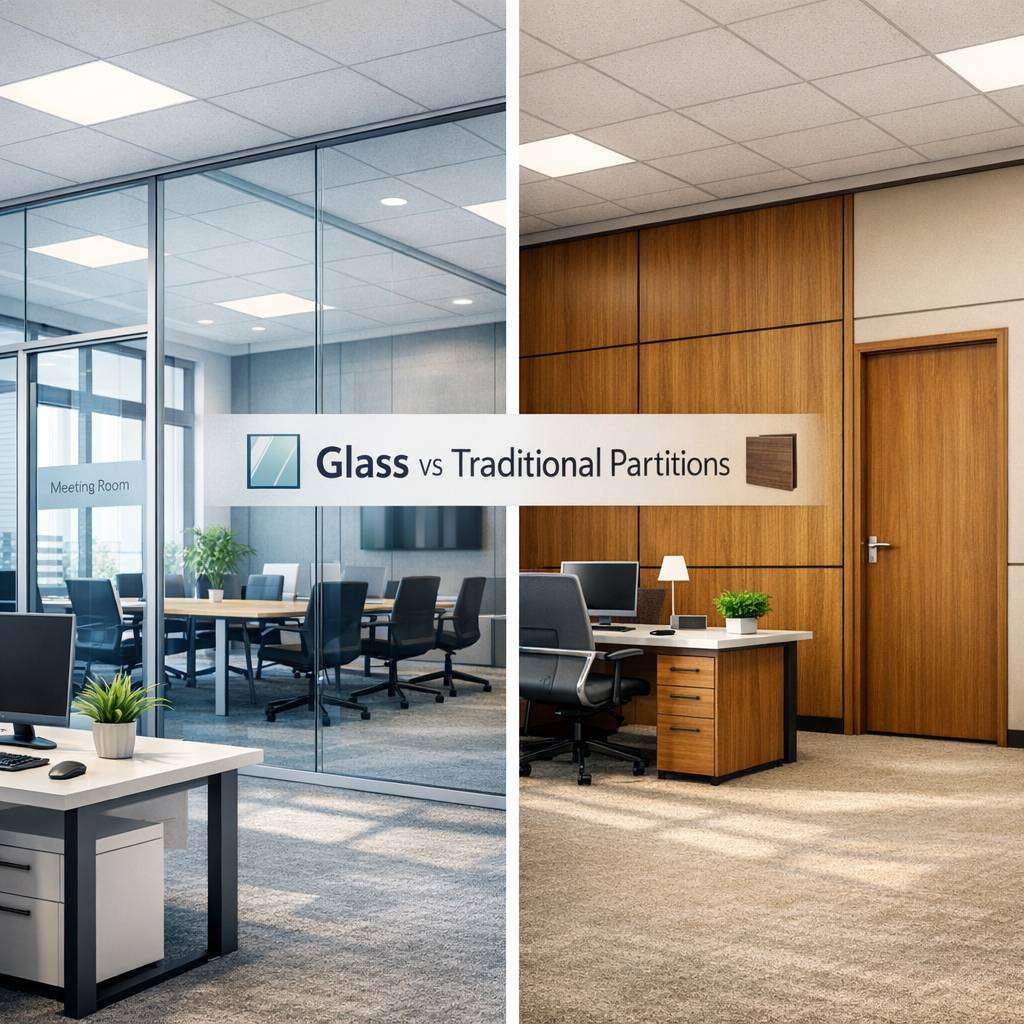
Creating an efficient, productive, and aesthetically pleasing workspace is a balancing act between light, sound, privacy, and budget. When it comes to dividing space, two broad options vie for attention: glass office partitions and traditional partitions. As an expert in workplace architecture and interior fit-outs, I’ve helped countless organisations weigh the pros and cons. Here’s a clear, friendly guide to help you decide which path suits your needs.
What glass partitions bring to the table
Glass partitions, including glass partition sliding doors and glass walls for office environments, offer a modern, open feel without sacrificing privacy or sound control. They’re often favoured in tech firms, design studios, law practices, and forward-thinking corporate spaces.
- Light and perception of space: Glass walls for office use maximise natural daylight, reduce the feeling of confinement, and can make corridors feel more expansive.
- Aesthetic appeal: Clean lines, contemporary finishes, and a sense of transparency can elevate your company brand and improve staff morale.
- Versatility: Movable glass office walls and glass panel partitions allow for flexible floor layouts. You can create open-plan zones or private rooms as needs evolve.
- Acoustic options: Modern laminated or laminated-with-acoustic-dampening glass can deliver effective sound insulation, balancing openness with concentration.
- Maintenance: Glass is easy to clean and maintain to a high standard, though it may require more frequent housekeeping in high-traffic areas.
The cost of glass office walls varies depending on thickness, framework, adhesives, and fittings. It’s common to see price ranges that reflect the premium nature of glass, but the long-term benefits—upgradeability, light transmission, and modern aesthetics—often offset initial outlay.
The appeal of traditional partitions
Traditional partitions are typically gypsum board, timber, metal stud, or fibreboard assemblies with solid or semi-solid panels. They’re reliable, budget-conscious, and straightforward to install. For many offices, especially those requiring robust privacy, sound attenuation, and quick, cost-effective reconfigurations, traditional partitions remain a strong contender.
- Cost efficiency: For many spaces, traditional partitions can be cheaper upfront, especially where high sound attenuation or fire-rated walls are not critical.
- Privacy and security: Solid walls offer immediate visual and acoustic privacy, which can be important for confidential meetings, HR, or executive spaces.
- Speed and simplicity: Installation is often quicker and less complex than framed glass systems, with fewer glazing concerns.
- Fire safety and compliance: Solid partition systems can be easier to specify for precise fire-rating requirements.
That said, some traditional partitions can lack the bright, open feel that modern workplaces crave. If the goal is collaboration, client-facing spaces with a contemporary look, glass often wins out.
Glass office partitions can transform any workspace, delivering a modern, airy feel while preserving privacy through smart design choices. They maximize natural light, reduce noise disruption, and create flexible zones for collaboration or focused work. When selecting options, consider frame finishes, thickness, and acoustic ratings to match your interior style and budget. For more inspiration and product ideas, explore leading ideas and case studies at https://www.urbansquare.net/ and discover how glass office partitions can elevate your environment.
When to choose glass office walls
- Brand and culture: If your company values openness, transparency, and collaboration, glass office walls align with your ethos.
- Natural light strategy: Organisations wanting to maximise daylight—especially in dense urban offices—benefit from glass walls for office layouts.
- Flexible spaces: If you anticipate frequent reconfiguration, glass panel partitions and movable glass office walls offer adaptability without major construction.
- Client impressions: A glass-fronted reception, conference rooms with glass partitions, or glass office walls cost can still convey sophistication and scale.
If you’re considering glass walls for meeting rooms or executive suites, ensure you select appropriate glass types (toughened, laminated, or acoustic variants) and framing that complement your acoustic and privacy needs. Glass partition sliding doors can also provide elegant access points without breaking the visual flow.
When to lean into traditional partitions
- Tight budgets: If the primary objective is to reduce costs quickly, traditional partitions can be more economical, particularly where high-end aesthetics are not a priority.
- Superior privacy and noise control: In environments where conversations must be shielded without leakage, solid walls can perform more consistently.
- Compliance and durability: In high-traffic or industrial settings, traditional partitions may better withstand abuse and meet certain regulatory requirements.
- Simpler maintenance: A straightforward surface finish can be easier to clean and repair in some contexts.
Comparing key considerations: sound, light, and maintenance
- Sound: Glass can be highly effective when paired with proper seals and acoustic linings, but traditional partitions with solid cores can offer superior sound privacy in some scenarios. For a mixed requirement, consider a hybrid approach—glass walls with acoustic treatments or partial solid cores.
- Light and openness: Glass partitions maximise light, supporting healthier work environments and potentially reducing energy costs related to artificial lighting.
- Maintenance and lifecycle: Regular cleaning is essential for glass, especially in busy reception or open-plan zones. Traditional partitions, particularly those with painted or laminated surfaces, may require less frequent intensive cleaning.
Glass partition sliding doors, glass offices walls cost, and practicalities
- Glass partition sliding doors: A stylish, space-saving option that reduces door swing and frees floor space. They pair well with both glass walls for office and mixed layouts, but ensure tracks and hardware are sized for the expected traffic and acoustic goals.
- Glass office walls cost: Factors include glass type (toughened vs laminated), thickness, frame system, hardware, and installation complexity. While the upfront cost may be higher, the benefits in light, aesthetics, and future flexibility can justify the investment.
- Office glass wall panels vs whole-wall solutions: Panels offer modularity and ease of reconfiguration, while full-wall installations create uninterrupted lines and maximum daylight. Your choice depends on your need for adaptability and visual continuity.
A practical approach to deciding
- Start with objectives: Do you prioritise openness and collaboration, or privacy and sound control?
- Assess space and lighting: Do you have sufficient daylight to support glass, or would you benefit from heavier traditional walls?
- Plan for future changes: If growth or reorganisation is likely, lean glass or modular panels for easy reconfiguration.
- Budget with lifecycle in mind: Consider not only the initial price but maintenance, potential energy savings, and resale value.
In short, glass office partitions and traditional partitions each have compelling arguments. Glass partitions, including glass partition sliding doors and movable glass office walls, excel when light, flexibility, and contemporary aesthetics are paramount. Traditional partitions shine where privacy, cost control, and straightforward durability are the priorities. By weighing light, sound, cost, and future-proofing, you can select the option that best aligns with your organisation’s goals and culture. If you’d like, I can help you run through a personalised comparison based on your space, budget, and performance targets.